
One inch is exactly 2.54 centimeters.
The Core Relationship: Why 1 Inch is Exactly 2.54 Centimeters
For decades, the relationship between the imperial system and the metric system was a source of minor but persistent discrepancies. Different English-speaking countries maintained slightly different physical standards for the yard and the pound, leading to tiny variations in precision manufacturing and scientific research. This changed on July 1, 1959, with the signing of the International Yard and Pound Agreement. Representatives from the United States, the United Kingdom, Canada, Australia, New Zealand, and South Africa agreed to standardize these measurements against the metric system.
Under this agreement, the international yard was defined as exactly 0.9144 meters. Since a yard contains exactly 36 inches, dividing 0.9144 meters by 36 yields exactly 0.0254 meters per inch. Because one meter is equal to 100 centimeters, multiplying 0.0254 meters by 100 gives us the exact conversion factor we use today: 1 inch is exactly 2.54 centimeters. This definition is absolute. Unlike many other unit conversions that require rounding to account for irrational numbers or repeating decimals, the conversion between inches and centimeters is mathematically precise. When you convert using the factor of 2.54, you are not using an approximation; you are using the legally and scientifically defined equivalent established by international treaty.
Sources: www.nist.gov
How to Convert Centimeters to Inches (Step-by-Step with Examples)
To convert a measurement from centimeters (cm) to inches (in), you must divide the centimeter value by the exact conversion factor of 2.54. The mathematical formula is:
Inches = Centimeters / 2.54
Let's walk through two practical examples to see how this works in real-world scenarios.
Example 1: Converting a standard paper size. Suppose you have an A4 sheet of paper, which has a width of 21 centimeters. To find its width in inches, take the centimeter value (21) and divide by 2.54. This yields approximately 8.2677. Rounding to a practical decimal place, such as two decimal places, gives you 8.27 inches.
Example 2: Converting human height. If a person's height is recorded as 180 centimeters, you can convert this to inches to make it more familiar for those accustomed to the US customary system. Take the centimeter value (180) and divide by 2.54. This yields approximately 70.8661. Rounding to the nearest tenth of an inch gives you 70.9 inches. To convert this further into feet and inches, divide 70.9 by 12 (since there are 12 inches in a foot). 70.9 divided by 12 is 5 with a remainder of 10.9, which translates to approximately 5 feet 11 inches.
How to Convert Inches to Centimeters (Step-by-Step with Examples)
Converting from inches to centimeters is even more straightforward because it involves multiplication rather than division. Because the conversion factor is a terminating decimal (2.54), multiplying any terminating decimal value of inches will always result in a terminating decimal value of centimeters. The mathematical formula is:
Centimeters = Inches * 2.54
Let's look at two common scenarios where this conversion is highly useful.
Example 1: Converting a screen size. A consumer is looking at a computer monitor advertised as having a 27-inch diagonal screen. To understand how large this is in centimeters, take the inch value (27) and multiply by 2.54. This equals exactly 68.58. The screen diagonal is exactly 68.58 centimeters. No rounding is required here because the result is a clean, terminating decimal.
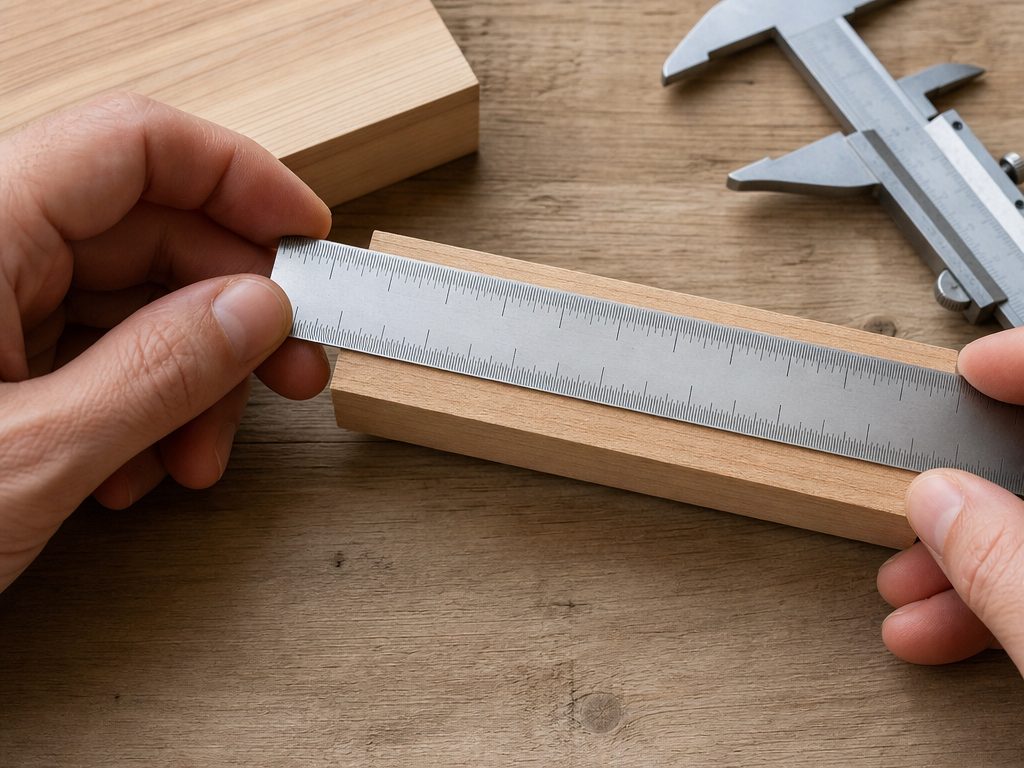
Example 2: Converting a woodworking measurement. A woodworker needs to cut a piece of lumber that is 8.5 inches long. To mark the cut using a metric ruler, take the inch value (8.5) and multiply by 2.54. This equals exactly 21.59. The woodworker should measure and mark exactly 21.59 centimeters (or approximately 216 millimeters) on the wood.
Practical Quick-Reference Conversion Tables
While a calculator provides exact figures, having a quick-reference table is invaluable for rapid estimation and mental checks. Below are two reference tables mapping common measurements between centimeters and inches.
Centimeters to Inches Reference Table:
- 1 cm = 0.3937 in (Approx. 3/8 in)
- 2.54 cm = 1.0000 in (Exactly 1 in)
- 5 cm = 1.9685 in (Approx. 2 in)
- 10 cm = 3.9370 in (Approx. 3 15/16 in)
- 20 cm = 7.8740 in (Approx. 7 7/8 in)
- 30 cm = 11.8110 in (Approx. 11 13/16 in)
- 50 cm = 19.6850 in (Approx. 19 11/16 in)
- 100 cm (1 m) = 39.3701 in (Approx. 39 3/8 in)
Inches to Centimeters Reference Table:
- 1/4 in (0.25) = 0.635 cm (Exact)
- 1/2 in (0.50) = 1.270 cm (Exact)
- 1 in = 2.540 cm (Exact)
- 2 in = 5.080 cm (Exact)
- 6 in = 15.240 cm (Exact)
- 12 in (1 ft) = 30.480 cm (Exact)
- 36 in (1 yd) = 91.440 cm (Exact)
These tables illustrate how the metric system scales cleanly by tens, while the imperial system relies on fractional subdivisions or larger units like feet and yards.
Common Pitfalls: Fractions, Decimals, and the Retired Survey Foot
One of the most common mistakes when converting from inches to centimeters is failing to handle fractions correctly. In the United States, measurements are frequently written as fractions (e.g., 5 5/8 inches). You cannot directly multiply a fraction by 2.54 without converting it to a decimal first. To convert a fraction like 5 5/8 inches, first divide the numerator by the denominator (5 / 8 = 0.625). Next, add the whole number (5 + 0.625 = 5.625 inches). Finally, multiply by 2.54 to get exactly 14.2875 centimeters.
Another fascinating historical pitfall involves the "U.S. survey foot." When the international foot was adopted in 1959, the United States chose to keep a slightly different definition of the foot—the U.S. survey foot (defined as exactly 1200/3937 meters)—specifically for geodetic surveying. This created a tiny discrepancy of about 2 parts per million between the international foot and the survey foot. While irrelevant for everyday measurements, this discrepancy caused significant coordination errors in large-scale mapping and engineering projects over decades.
To resolve this confusion, the National Institute of Standards and Technology (NIST) and the National Geodetic Survey (NGS) officially retired and deprecated the U.S. survey foot on December 31, 2022. Starting January 1, 2023, the international foot (exactly 0.3048 meters) became the sole official standard for all applications in the United States. This modernization ensures that all modern calculations align perfectly with the international definition of 2.54 centimeters per inch. For legacy surveying projects, users should consult local state geodetic offices to verify if historical survey feet are still referenced in older regional documents.
Sources: www.nist.gov, www.federalregister.gov
Real-World Applications: When to Use Centimeters vs. Inches
Choosing whether to use centimeters or inches often depends on your industry, geographic location, and the specific task at hand.
Apparel and Sizing: Globally, most clothing manufacturers use centimeters for precise sizing charts, especially for international shipping. However, in the United States and the United Kingdom, waist, chest, and inseam measurements are still predominantly displayed in inches. If you are purchasing clothes from an international retailer, converting your measurements to centimeters is crucial to ensuring a proper fit.
Healthcare and Medicine: In clinical settings worldwide, including the United States, patient height and weight are recorded in metric units (centimeters and kilograms). This standardization reduces the risk of dosage errors, which are often calculated based on body surface area or weight.
Technology and Screens: Interestingly, the tech industry has globally standardized screen sizes in inches. Whether you are in Tokyo, Paris, or New York, television, smartphone, and computer monitor diagonals are almost always marketed in inches.
Construction and Woodworking: In the US, construction plans rely heavily on feet, inches, and fractional inches (e.g., 1/16th of an inch). In contrast, international projects utilize millimeters and centimeters, which eliminate the need to calculate complex fractions on-site.
By understanding how to seamlessly transition between these two measurement systems, you can avoid costly errors in DIY projects, shopping, and professional applications.