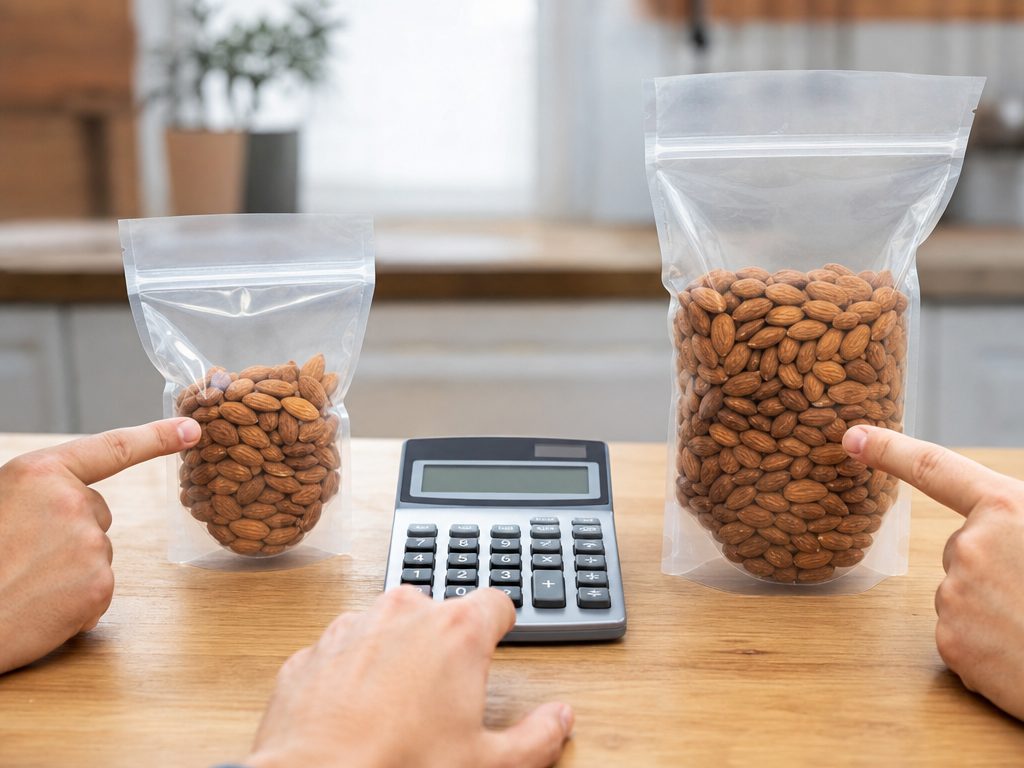
Enter both sizes in the same unit, or the comparison is meaningless.
The larger package is not always cheaper per unit, which is the whole reason to check.
The Psychology of Packaging and the Illusion of Bulk Savings
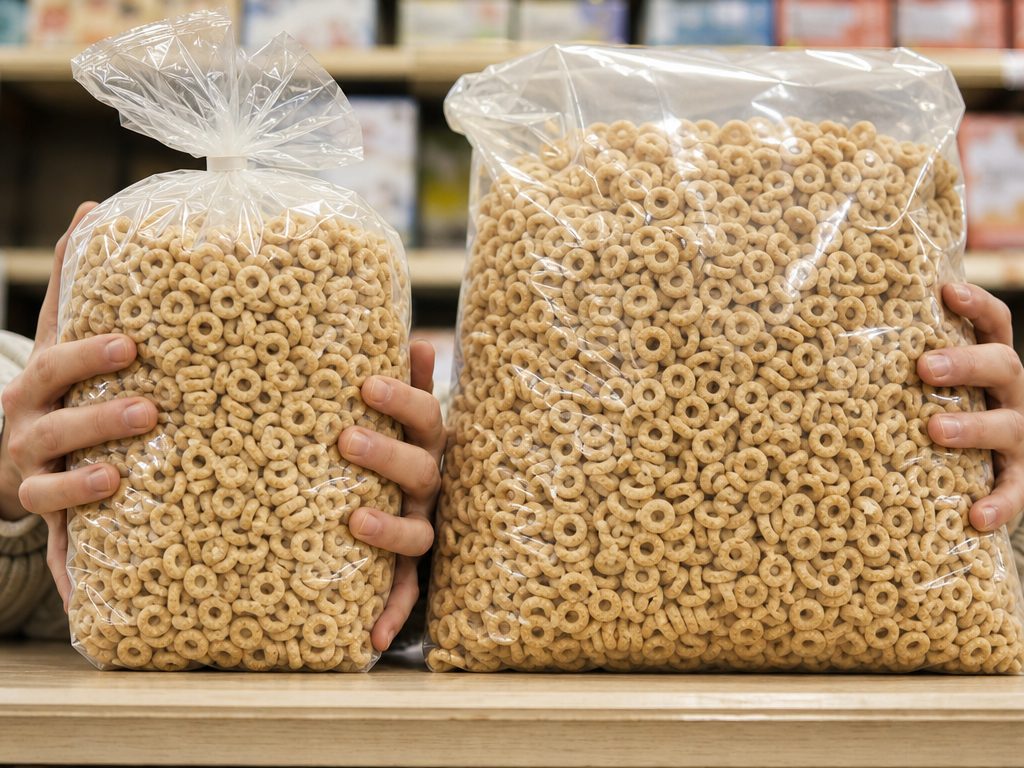
When walking down the aisles of a modern supermarket, consumers are bombarded with marketing cues designed to influence their purchasing decisions. One of the most pervasive cognitive shortcuts shoppers rely on is the 'quantity discount' heuristic—the deeply ingrained belief that buying a larger quantity of a product automatically yields a lower cost per unit. Retailers and manufacturers are well aware of this psychological bias and frequently exploit it through a phenomenon known as 'bulk markup' or 'reverse unit pricing.' In these scenarios, the larger, family-sized, or bulk package is actually more expensive per ounce, gram, or sheet than its smaller counterpart.
This pricing anomaly occurs for several reasons. First, manufacturers understand that convenience and the perception of value can override active calculation. A shopper rushing through a store is highly likely to grab the largest tub of peanut butter or the biggest bottle of laundry detergent under the assumption that they are making the economically superior choice. Second, packaging and distribution costs do not always scale linearly. Sometimes, the specialized packaging required for oversized items, or the shelf space they occupy, drives up the retail cost. Without a reliable way to compare these options side-by-side, consumers routinely overpay for the illusion of bulk savings.
The Unit Price Comparison Calculator serves as an essential tool to strip away marketing distractions and reveal the raw mathematical truth of any transaction. By focusing strictly on the cost per standardized unit of measurement, you can bypass deceptive packaging designs, promotional endcaps, and confusing pricing displays. Whether you are comparing two different brands, two different sizes of the same product, or evaluating a limited-time sale against a standard package, calculating the precise unit price is the only definitive way to ensure your hard-earned money is being spent efficiently.
Sources: consumerreports.org
How to Use the Unit Price Comparison Calculator Effectively
Using the Unit Price Comparison Calculator is a straightforward process, but its accuracy depends entirely on the consistency of the data you input. To perform a valid comparison, you must enter the total price and the total package size for two distinct options. The calculator then divides the price by the size to determine the unit cost for each option, highlighting which selection offers the superior value and calculating the exact percentage of your savings.
However, there is one critical rule that you must observe: enter both sizes in the same unit, or the comparison is completely meaningless. For example, if you attempt to compare a 2-pound bag of rice with a 24-ounce bag of rice without converting them to a common unit, the calculator will treat '2' and '24' as equivalent metrics, leading to an entirely incorrect conclusion. To avoid this pitfall, you must convert one of the measurements so they match. In this scenario, because there are 16 ounces in a pound, you would either convert the 2-pound bag into 32 ounces (allowing a comparison of 32 ounces versus 24 ounces) or convert the 24-ounce bag into 1.5 pounds (allowing a comparison of 2 pounds versus 1.5 pounds).
This rule applies across all categories of goods. When comparing liquid items like milk, juice, or liquid detergent, ensure both options are entered in fluid ounces, milliliters, liters, or gallons. For dry goods, stick consistently to ounces, pounds, grams, or kilograms. For paper products like paper towels or toilet paper, you can compare the total square footage or the total sheet count, provided you use the same metric for both Option A and Option B. By standardizing your inputs before entering them into the calculator, you guarantee an apples-to-apples comparison that exposes the true bargain.
The Mathematical Formulas Behind Unit Price Calculations
To fully appreciate how the calculator operates, it is helpful to understand the underlying mathematics. The fundamental formula for determining a unit price is exceptionally simple:
Unit Price = Total Price / Total Units
For example, if Option A is a 12-ounce box of cereal priced at $4.50, the calculation is:
$4.50 / 12 ounces = $0.375 per ounce
If Option B is an 18-ounce box of the same cereal priced at $6.48, the calculation is:
$6.48 / 18 ounces = $0.360 per ounce
In this case, Option B is the more economical choice, saving you $0.015 per ounce. To determine the percentage savings of choosing the cheaper option over the more expensive one, the calculator uses the following formula:
Percentage Savings = ((Higher Unit Price - Lower Unit Price) / Higher Unit Price) * 100
Using our cereal example:
(($0.375 - $0.360) / $0.375) * 100 = (0.015 / $0.375) * 100 = 4% savings
Let us examine a more complex real-world scenario involving different packaging configurations. Suppose you are standing in the dairy aisle trying to choose between a 3-pound tub of Greek yogurt priced at $5.99 and a convenient multi-pack containing eight individual 5.3-ounce cups priced at $6.49. First, you must convert the 3-pound tub into ounces. Since one pound equals 16 ounces, the tub contains 48 ounces (3 * 16). Next, calculate the total ounces in the multi-pack: 8 cups multiplied by 5.3 ounces per cup equals 42.4 ounces.
Now, apply the unit price formula to both:
Tub Unit Price: $5.99 / 48 ounces = $0.1248 per ounce
Multi-Pack Unit Price: $6.49 / 42.4 ounces = $0.1531 per ounce
Comparing the two, the tub is significantly cheaper per ounce. The percentage savings of buying the tub over the multi-pack is:
(($0.1531 - $0.1248) / $0.1531) * 100 = (0.0283 / 0.1531) * 100 = 18.48% savings
While the individual cups offer convenience, the math reveals that you are paying an 18.48% premium for that pre-portioned packaging. Armed with this mathematical clarity, you can make an informed decision about whether the convenience is worth the extra cost.
State Regulations and the Evolution of Unit Pricing Laws
While unit pricing is an invaluable tool for consumers, its availability on store shelves is not universally mandated. In the United States, there is no federal law requiring retailers to display unit prices. Instead, regulation is left entirely to individual states, resulting in a patchwork of laws that vary significantly across the country. Some states mandate unit pricing for a wide range of consumer commodities, others have voluntary guidelines, and some have no regulations whatsoever.
Massachusetts has long been a pioneer in consumer protection and unit pricing enforcement. For over two decades, the Commonwealth has maintained strict unit pricing regulations, while exempting small retail establishments with less than $5 million in annual in-store sales to prevent placing an undue administrative burden on local businesses. However, as economic conditions evolved, this threshold required modernization. On February 26, 2026, Massachusetts enacted Senate Bill No. 2978 (S.2965) to address this issue.
It is important to clarify that this February 2026 update did not introduce a brand-new exemption for small stores. Rather, it adjusted the calculation of the existing $5 million threshold to exclude gross receipts from the sale of lottery tickets, prepaid gift cards, and motor fuels (fuel receipts). This targeted adjustment was designed specifically to preserve and maintain the long-standing small-store exemption. Due to high inflation and the rising face value of lottery products and gift cards, many small neighborhood bodegas and corner markets were being artificially pushed over the $5 million threshold, despite their core grocery sales remaining small. By excluding these non-grocery receipts from the calculation, the legislature ensured that independent local retailers could continue to operate without the costly overhead of complex unit pricing systems, while preserving the mandate for major supermarket chains. To review the specific statutory language and track ongoing regulatory adjustments, consumers and business owners can consult the official Massachusetts Legislature portal.
Sources: malegislature.gov
Dynamic Pricing, Electronic Shelf Labels, and Surveillance Pricing Bans
The retail landscape is undergoing a rapid technological transformation with the widespread adoption of Electronic Shelf Labels (ESLs). While ESLs allow retailers to update prices instantly and reduce paper waste, they also enable 'dynamic pricing'—the practice of changing prices in real-time based on fluctuating demand, inventory levels, or competitor pricing. A more controversial extension of this technology is 'surveillance pricing,' where retailers leverage consumer data, tracking algorithms, and loyalty program insights to dynamically adjust prices for individual shoppers.
In response to growing concerns over price discrimination and predatory practices, state legislatures have begun taking decisive action to protect consumers. Maryland became the first state in the nation to ban grocery surveillance pricing when it enacted the Protection from Predatory Pricing Act in April 2026, with the law officially taking effect on October 1, 2026. Following Maryland's lead, Connecticut became the second state to pass a surveillance pricing ban when Governor Ned Lamont signed Senate Bill 4 (Public Act No. 26-64) into law on June 4, 2026. Shortly thereafter, New Jersey became the third state to establish these protections when Governor Mikie Sherrill signed the Fair Price Protection Act on July 23, 2026.
These landmark legislative measures are designed to prevent grocery stores and other retailers from using personal surveillance data to hike prices dynamically on essential goods. However, because dynamic pricing based on general store demand and inventory remains legal in most jurisdictions, prices on the shelves can still change much more frequently than they did in the era of paper tags. This volatility makes personal vigilance essential. Carrying a digital unit price comparison tool allows you to verify that a sudden price change has not quietly eroded the value of your preferred products, ensuring you remain in control of your household budget regardless of shifting retail technologies. To stay informed about the evolving legal landscape of consumer data privacy and retail pricing in your area, consult official state government portals such as the New Jersey State website or consumer advocacy organizations like the Electronic Privacy Information Center.
Qualitative Trade-Offs: When the Cheaper Unit Price Isn't the Best Choice
While the Unit Price Comparison Calculator provides absolute mathematical clarity, the option with the lowest unit price is not always the smartest purchase. Smart shopping requires balancing pure financial metrics with qualitative factors that affect your household's lifestyle, storage capacity, and consumption habits. Failing to account for these variables can turn an apparent bargain into a costly mistake.
The most significant trade-off to consider is spoilage and waste. Buying a massive, five-pound container of spinach or a gallon of fresh salsa because it features a remarkably low unit price is only a saving if you consume the entire package before it spoils. If you end up throwing away half of the product, your actual cost per unit consumed doubles, completely wiping out any initial savings. For perishable goods, it is almost always more economical to buy a smaller quantity that you are certain to finish, even if the unit price is slightly higher.
Another critical factor is storage and physical handling. Bulk items require adequate pantry, freezer, or closet space. If your living space is limited, overcrowding your home with bulk toilet paper or oversized detergent bottles can create unnecessary clutter and stress. Additionally, consider the upfront cash flow required for bulk shopping. Purchasing larger sizes requires more capital at the checkout counter. If buying the bulk option strains your weekly grocery budget, it may force you to compromise on other essential items. Finally, be vigilant about 'shrinkflation'—the practice where manufacturers subtly reduce the volume of a product while keeping the package size and price identical. Regularly running your favorite items through the calculator ensures that hidden package downsizes do not quietly inflate your cost of living over time.
Sources: consumerreports.org