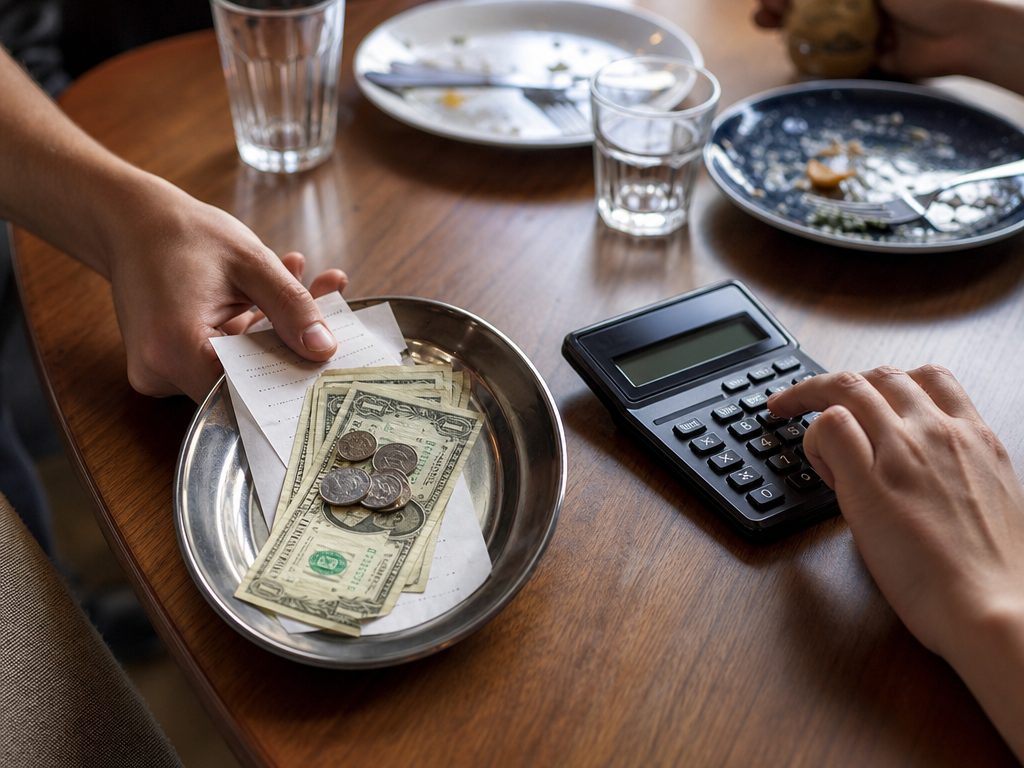
Always check your receipt for automatic service charges or gratuities before adding a tip, as these are legally binding and already included in your total.
The Mathematics of Bill Splitting and Tipping
Calculating a restaurant bill seems straightforward, but the math quickly becomes complicated when tax, tips, and multiple diners are introduced. To understand the core mechanics, we must break down the standard calculation sequence. First, the subtotal is the sum of all food and beverage items ordered. Next, local sales tax is applied to this subtotal. The tip is then calculated as a percentage of either the pre-tax subtotal or the post-tax total. Finally, the overall total is divided by the number of people in the party to determine the per-person share.
Historically, the standard etiquette has been to calculate the tip based on the pre-tax subtotal. For example, if a party's subtotal is $100.00 and the local sales tax rate is 8.25%, the tax is $8.25, bringing the post-tax total to $108.25. If the group decides to leave a 20% tip on the pre-tax subtotal, the tip amount is $20.00 ($100.00 x 0.20), resulting in a final bill of $128.25. However, if they calculate the 20% tip on the post-tax total, the tip rises to $21.65 ($108.25 x 0.20), making the final bill $129.90. This creates a difference of $1.65. While this discrepancy may seem negligible on a single receipt, it can accumulate significantly over time for frequent diners.
Modern point-of-sale (POS) systems, such as Toast, Clover, and Square, have shifted consumer behavior by defaulting their suggested tip screens to post-tax calculations. This means that when a tablet is turned toward you with 18%, 20%, or 22% options, those percentages are almost always calculated on the post-tax total, which includes state and local taxes. Tipping on tax is essentially paying a percentage on a government levy, which is why financial purists recommend manually calculating tips on the pre-tax subtotal. To do this quickly without a calculator, locate the tax amount on your receipt; if your local tax rate is around 8% to 10%, doubling the tax amount provides an instant 16% to 20% tip estimate based on the pre-tax subtotal.
Sources: www.toasttab.com
Modern Tipping Benchmarks and the Rise of 'Tip Creep'
Tipping expectations have evolved rapidly over the last decade, accelerated by the transition to cashless payments and digital ordering platforms. In full-service restaurants (FSR) across the United States, the standard benchmark for acceptable service is now 18% to 20%, with 15% increasingly viewed as a minimum for subpar service. According to transaction data published by Toast, average tips at full-service establishments consistently hover between 18.8% and 19.4%, reflecting a deeply ingrained cultural norm of supporting service staff who often rely on tips to meet basic living standards.
Conversely, quick-service restaurants (QSR), coffee shops, and counter-service establishments present a different landscape. Historically, tipping at a counter was reserved for a physical jar where customers dropped spare change. Today, digital payment terminals present customers with pre-set tipping prompts—often starting at 15%, 18%, or even 20%—before the transaction can be completed. This phenomenon, colloquially termed 'tip creep' or 'tip fatigue,' has sparked widespread consumer frustration. Transaction data indicates that while counter-service tips are lower on average—typically ranging from 14% to 16%—the frequency of these prompts has led to a psychological backlash.
To navigate this without guilt, it helps to establish personal guidelines. Tipping at counter-service operations remains entirely optional. A baseline of 10% or a flat $1 to $2 is highly appreciated for baristas or counter staff who perform custom preparation, but there is no ethical obligation to tip for a simple transaction where a pre-packaged item is handed over. Understanding these benchmarks allows consumers to make deliberate, stress-free financial decisions rather than reacting to the social pressure of a digital screen.
Sources: www.toasttab.com
Legal Distinctions: Voluntary Tips vs. Mandatory Service Charges
Many diners are surprised to learn that the extra charges on their restaurant bills are governed by strict legal definitions. The Internal Revenue Service (IRS) maintains a clear distinction between a voluntary tip and a mandatory service charge. According to IRS guidelines, a payment is classified as a tip only if it meets four specific criteria: it must be entirely voluntary; the customer must have the unrestricted right to determine the amount; the amount cannot be dictated by employer policy or subject to negotiation; and the customer generally has the right to decide who receives the payment. If any of these conditions are missing, the payment is legally classified as a service charge.
This distinction is highly relevant when dining in large groups. Most restaurants automatically apply a 'gratuity' of 18% or 20% for parties of six, eight, or more. Because this fee is mandatory and dictated by restaurant policy, the IRS rules that it is a service charge, not a tip. This has significant legal and financial ramifications. For the restaurant, service charges are treated as regular business revenue. Consequently, they are subject to state sales tax in many jurisdictions, meaning you may be taxed on the mandatory gratuity itself. Furthermore, when the restaurant distributes these funds to the service staff, they must be treated as regular W-2 wages rather than tips, impacting payroll tax calculations and employee benefits.
For the consumer, the most critical takeaway is the 'double-tipping' trap. Because automatic gratuities are legally service charges, they are already added to the bill's final total. Diners must carefully inspect their receipts for terms like 'service charge,' 'automatic gratuity,' or 'service fee' before adding an additional tip. Adding a standard 20% tip on top of a bill that already includes an automatic 18% service charge results in an astronomical 38% total gratuity. Unless the service was exceptionally extraordinary and you wish to offer an additional voluntary reward, you are not expected to tip on top of a mandatory service charge.
Sources: www.irs.gov
Bill Splitting Etiquette and Social Dynamics
Splitting a bill at the end of a group meal is a notorious source of social friction. The two primary methods for resolving a group check are the even split and the itemized split, each with distinct advantages and drawbacks. An even split—dividing the total bill equally by the number of diners—is the most efficient and socially seamless method. It is highly recommended when everyone orders roughly the same volume of food and drink. This approach minimizes math at the table, reduces the burden on the restaurant staff, and projects a sense of shared experience and generosity among friends.
However, an even split becomes highly unfair when there are significant discrepancies in what individuals ordered. For instance, if one guest orders a simple house salad and tap water (totaling $15.00) while another orders a prime ribeye steak and three premium cocktails (totaling $85.00), an even split forces the light eater to heavily subsidize the heavy spender. In these scenarios, an itemized split is the only equitable solution. To execute an itemized split fairly, each person should calculate the cost of their individual items, add a proportional share of the shared tax, and apply their chosen tip percentage to their subtotal.
To prevent awkwardness, etiquette experts emphasize the importance of upfront communication. Group coordinators should establish how the bill will be handled before anyone sits down or orders. If the group decides to request separate checks from the restaurant, this request must be communicated to the server before the first order is placed. This allows the server to organize the table's items in their POS system from the beginning, preventing a logistical nightmare at the end of the meal. If separate checks are not possible, designating one person to pay the entire bill on a credit card—allowing others to reimburse them digitally—is often the most polite and efficient compromise.
Sources: www.irs.gov
Digital Tools and Apps for Seamless Splitting
The rise of financial technology has revolutionized how groups manage shared expenses, shifting the burden away from manual calculations and cash exchanges. Today, several specialized applications cater to different bill-splitting scenarios. For ongoing group expenses, such as multi-day trips, roommate expenses, or vacation rentals, Splitwise is the industry standard. It allows users to input various expenses over time, specify who paid for what, and automatically calculate the most efficient path for everyone to settle their debts at the end of the period.
For immediate, single-meal transactions, peer-to-peer payment platforms like Venmo, Cash App, and Zelle are indispensable. The most common workflow involves one diner paying the entire restaurant bill with their credit card to earn loyalty points, then immediately requesting the precise amounts from the other guests. To make this process even easier, specialized receipt-scanning apps like Tab allow users to take a photo of the paper receipt. The app digitizes the line items, allowing diners to tap on the items they ordered. The app then automatically calculates the exact tax and tip proportional to each person's individual items, eliminating manual math entirely.
While digital tools simplify the process, group dining coordinators should follow a basic checklist to ensure a smooth experience. First, confirm that everyone in the group has access to the chosen payment platform before the meal. Second, ensure the person paying the bill has sufficient credit limit or funds to cover the total amount. Third, settle all digital requests within 24 hours of the meal to avoid lingering financial awkwardness. By leveraging these tools responsibly, groups can enjoy their dining experiences without the stress of complex mental math.
Sources: www.splitwise.com
International Tipping Guide and Regional Variations
Tipping customs vary dramatically around the globe, and applying North American standards in other countries can lead to confusion, embarrassment, or even offense. In the United States and Canada, high tipping percentages (15% to 20%+) are deeply structural, as labor laws allow employers to pay tipped workers a sub-minimum wage, making tips a vital component of their take-home pay. However, this model is highly unique, and travelers must adapt their behavior when crossing borders.
In most European countries, tipping is far more conservative. Hospitality workers are paid living wages, and service is often legally integrated into the menu prices. In France, for example, bills include a 15% service charge labeled as service compris. While it is customary to leave a small amount of change or round up to the nearest five or ten euros for good service, leaving a large 20% tip is unnecessary and unusual. Similarly, in Italy, a small cover charge called coperto is often added to the bill to cover bread and table settings, and additional tipping is not expected unless the service was exceptional.
In contrast, tipping is virtually non-existent and can even be considered offensive in East Asian countries like Japan and South Korea. In Japanese culture, providing excellent service is viewed as a fundamental duty of employment, and offering extra money can be interpreted as a sign of condescension or confusion. If you leave extra cash on a table in Tokyo, the server will likely chase you down the street to return the money you forgot. Meanwhile, in countries like Australia and New Zealand, tipping is not traditional due to robust minimum wage laws, though a 10% tip for outstanding service at high-end restaurants is increasingly accepted. To avoid cultural missteps, travelers should always consult official tourism boards or reputable travel guides to verify current local customs before arriving at their destination.
Sources: www.irs.gov