The Psychology of Travel Anxiety: Auditing Your "Just in Case" Mindset
Overpacking is rarely a physical problem; it is a psychological one. The urge to pack more than we need is driven by travel anxiety—specifically, the fear of being unprepared for unpredictable scenarios. Many travelers pack for hypothetical events, such as sudden formal dinners, unexpected downpours, or drastic temperature drops, that rarely occur. This "just in case" mindset acts as a psychological defense mechanism against the discomfort of the unknown. To break this cycle, you must shift your mindset from packing for "what if" to packing for "what is." Realistically evaluate your itinerary and accept that if an absolute emergency arises, you can almost certainly purchase a replacement item or utilize local laundry services at your destination.
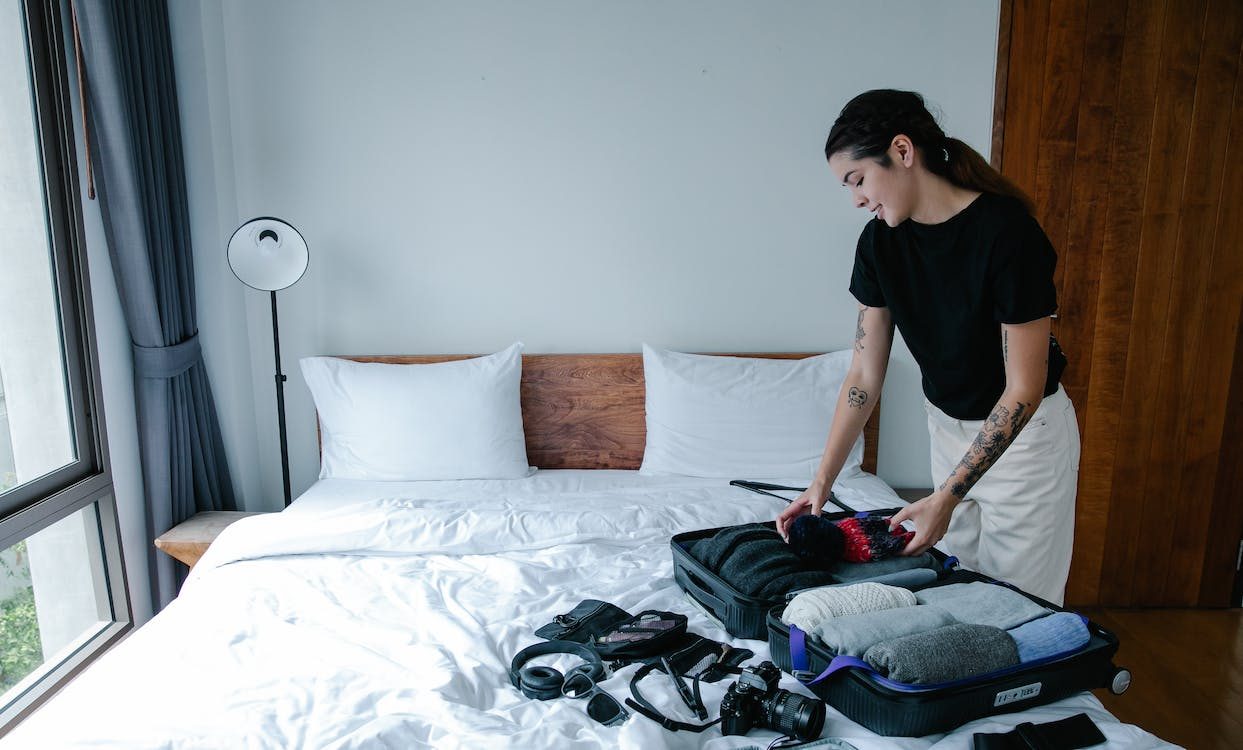
To put this into practice, perform a pre-packing audit. Lay out every single item you plan to bring on a flat surface, such as a bed or a large table. Categorize each item into "essentials" (items you will use daily, like underwear, primary tech, and daily medications) and "optionals" (items packed just in case, like a third pair of shoes or an extra dressy outfit). Force yourself to remove at least half of the optional category. If you find yourself hesitating over a specific item, ask yourself: "Can I easily buy this for under $10 at my destination if I absolutely need it?" If the answer is yes, leave it behind. Remind yourself that carrying a lighter bag yields immediate physical benefits, saving you from shoulder strain, transit fatigue, and the stress of navigating crowded public transportation with heavy luggage.
The 5-4-3-2-1 Rule: Engineering a Modular Capsule Wardrobe
One of the most effective frameworks for limiting clothing bulk is the 5-4-3-2-1 rule. This modular packing method limits your wardrobe to five sets of socks and underwear, four tops, three bottoms, two pairs of shoes, and one hat or outerwear piece. By restricting the sheer volume of clothing, you force yourself to select highly versatile garments that can be layered and mixed to create dozens of distinct outfits. This system ensures you have enough clothing for a week of travel without ever needing to check a bag.
To make this system work, stick to a cohesive color palette. Choose two neutral base colors (such as navy, black, or grey) and one accent color (such as olive green, burgundy, or mustard yellow). Every top should easily pair with every bottom in your bag, allowing you to mix and match effortlessly. Furthermore, prioritize lightweight, synthetic, or merino wool fabrics over heavy cottons. Merino wool is particularly valuable for travel because it naturally resists odors, regulates body temperature, and dries quickly, allowing you to wash items in a hotel sink and air-dry them overnight. Synthetics like polyester and nylon are also excellent for their durability and wrinkle resistance, whereas cotton holds onto moisture and odors, making it a poor choice for minimalist travel.
For example, with four tops (a merino t-shirt, a linen button-down, a technical polo, and a lightweight crewneck) and three bottoms (tailored chinos, travel-friendly tech pants, and versatile shorts), you can generate twelve unique outfits. This easily covers a two-week trip when combined with mid-trip laundry. By engineering a modular capsule wardrobe, you eliminate decision fatigue on the road and ensure that every item of clothing earns its place in your bag.
The Art of the Personal Item: Maximizing Your Under-Seat Real Estate
For budget-conscious travelers, mastering the "personal item" is the ultimate cost-saving skill. Following the permanent shutdown of Spirit Airlines on May 2, 2026, other ultra-low-cost carriers like Frontier Airlines and Allegiant Air have become the primary budget options in the United States, alongside Ryanair in Europe. These airlines enforce strict size limits for free under-seat bags, and violating these can lead to steep gate fees. On Frontier Airlines, the maximum size for a free personal item is 14 x 18 x 8 inches (35 x 45 x 20 cm). Meanwhile, Ryanair limits free personal bags to 40 x 30 x 20 cm. These dimensions include handles, wheels, and any bulging pockets. If your bag exceeds these limits by even a fraction of an inch, gate agents may charge you a hefty fee, which can climb up to $99 or more if assessed at the boarding gate.
To maximize this limited space, choose a soft-sided backpack or duffel rather than a hard-shell case. Soft bags can be compressed slightly to fit into the metal sizing boxes at the gate. Pack your personal item with high-value, quick-access essentials: your passport, electronics, medications, and a single change of clothes in case your overhead carry-on is gate-checked. Treat this bag as your mobile command center, keeping it organized with dedicated tech pouches so you never have to scramble through your belongings mid-flight. By utilizing the space under the seat in front of you strategically, you can bypass overhead bin competition entirely and speed through the airport.
Sources: www.flyfrontier.com, www.ryanair.com
Compression vs. Weight: The Science of Spatial Optimization
How you arrange items inside your bag is just as important as what you bring. Standard folding creates air pockets and structural chaos, leading to wasted space and wrinkled garments. Instead, utilize a combination of rolling and bundle packing. Rolling soft garments like t-shirts, activewear, and undergarments into tight cylinders prevents deep creases and allows them to fit snugly into the gaps between larger items.
For structured items like button-down shirts or blazers, try the bundle packing method, where you wrap garments around a central core of soft items (like socks and underwear) to avoid sharp folds. To organize these bundles, invest in double-zipper compression packing cubes. These cubes feature an extra zipper designed to expel excess air, shrinking the volume of your clothing by up to 30 percent. However, use caution: compression cubes do not reduce weight, so monitor your bag’s total mass to avoid exceeding airline limits. When packing your bag, place the heaviest items—such as shoes or toiletry kits—near the wheels or bottom of the bag. This lowers the center of gravity, making your suitcase much easier to roll and preventing it from tipping over when standing upright.
To execute the bundle packing method successfully, start by placing your most wrinkle-prone item (such as a blazer) flat on your bed, face down, with the sleeves extended. Layer subsequent garments on top, rotating their orientation by 90 degrees each time. Place a soft, filled packing cube or pouch in the center to act as the core. Fold the sleeves and bottoms of each garment tightly over the core, one by one, wrapping the entire bundle into a neat, secure package. This tension-based packing method prevents fabrics from shifting and creasing during transit, ensuring you arrive at your destination with freshly pressed clothes without needing an iron.
Footwear Discipline: The Two-Pair Maximum and Dead-Space Reclamation
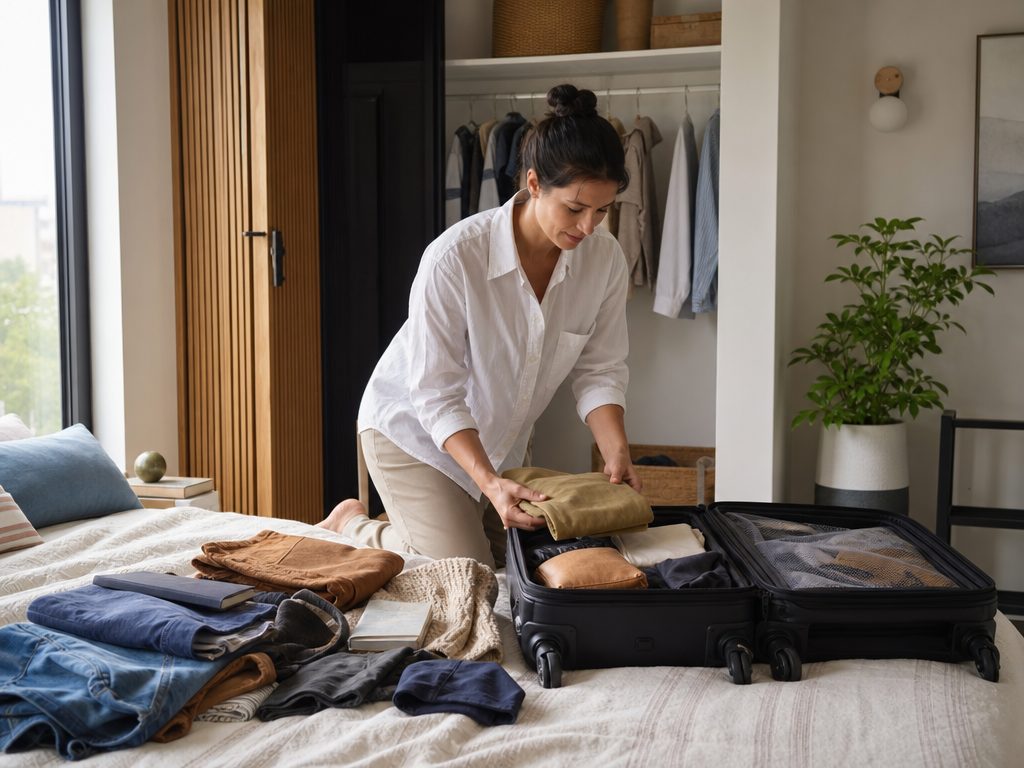
Shoes are heavy, bulky, and exceptionally difficult to pack efficiently. Because of this, you should enforce a strict two-pair limit for almost any trip. Wear your heaviest, bulkiest footwear—such as hiking boots or thick sneakers—on the plane or during transit. Pack your second, lighter pair flat at the bottom of your luggage. This second pair should be highly versatile, such as a sleek pair of loafers, Chelsea boots, or low-profile dress sneakers that can transition easily from daytime sightseeing to a formal dinner.
To maximize the space occupied by your packed shoes, treat them as storage containers. Stuff the interiors of your shoes with small, malleable items like socks, chargers, rolled underwear, or fragile souvenirs wrapped in cloth. This not only preserves the structural shape of your shoes under pressure but also reclaims valuable dead space that would otherwise go unused. Place packed shoes in lightweight shoe bags or plastic shower caps to keep the rest of your clothing clean and free of dirt. By enforcing this two-pair maximum, you eliminate one of the most common causes of overweight baggage.
When selecting your two pairs of shoes, prioritize comfort and utility over aesthetics. Ensure both pairs are thoroughly broken in before your departure to avoid painful blisters that can ruin your itinerary. If your trip involves specialized activities like scuba diving or rock climbing, rent the necessary footwear at your destination rather than packing single-use gear. By restricting your footwear and reclaiming the interior volume of your packed shoes, you can save up to 20% of your total luggage capacity.
Decanting and the Solid Revolution: Navigating Global Liquid Rules
Toiletries are a primary culprit of heavy, bloated luggage. Under the standard Transportation Security Administration (TSA) 3-1-1 liquids rule, all liquids, gels, and aerosols must be in containers of 3.4 ounces (100 milliliters) or less and fit into a single quart-sized, clear plastic bag. To streamline this category, transition to solid alternatives wherever possible. Solid shampoo bars, conditioner bars, solid deodorants, and toothpaste tablets completely bypass liquid restrictions and eliminate the risk of messy spills inside your bag. Be aware, however, that some "solid" products like cleansing balms or gel moisturizers can still be flagged as liquids by advanced screening systems if they are spreadable.
Crucially, airport security screening rules regarding liquids are undergoing a major transition in 2026. Many modern airports utilize advanced 3D CT scanners that allow liquids and laptops to remain inside your bag during screening. In the United Kingdom, major hubs like London Heathrow, Edinburgh, and Birmingham have officially removed the 100ml liquid limit, allowing passengers to carry containers of up to 2 litres of liquids, pastes, and gels in their hand luggage. However, this rollout is highly fragmented. Other UK airports like London City, Stansted, and Manchester still enforce the 100ml limit. Similarly, the standard 100ml rule remains strictly in place across the United States and most of the European Union. Always verify the current baggage and security screening rules of your departure, transit, and arrival airports before traveling to avoid having expensive products confiscated. For the most up-to-date regulations, refer directly to the TSA Liquids Rule page and the UK Government's official hand luggage guidelines.
Sources: www.tsa.gov, www.gov.uk, www.heathrow.com, www.gatwickairport.com
Tech and Power Consolidation: Trimming the Digital Fat
In the modern digital age, tech accessories can quickly add unexpected weight and clutter to your carry-on. To avoid the "cable tangle" trap, audit your electronics and consolidate your chargers. Instead of packing separate power bricks for your laptop, phone, tablet, and e-reader, invest in a single high-wattage Gallium Nitride (GaN) charger. GaN chargers are significantly smaller, lighter, and more efficient than traditional silicon chargers, and they often feature multiple USB-C and USB-A ports to charge all your devices simultaneously.
Pair your GaN charger with a universal travel adapter that includes built-in USB ports, eliminating the need for multiple plug adapters. Consolidate your entertainment by loading books onto an e-reader or tablet rather than carrying physical paperbacks. Additionally, download your favorite movies, podcasts, and offline maps directly to your smartphone before departure. By minimizing physical media and streamlining your power accessories, you can easily shave off several pounds of dead weight from your personal item. Keep your cables organized in a small, dedicated tech pouch to prevent them from tangling and to make security checkpoints a breeze.
When organizing your tech pouch, use elastic loops or velcro cable ties to secure each cord. Place your power bank in an easily accessible pocket, as aviation safety regulations strictly forbid spare lithium-ion batteries in checked baggage; they must be carried in the cabin. Additionally, ensure all your electronic devices are fully charged before heading to the airport, as security officers at some international checkpoints may require you to power them on to prove they are functional.
Laundry on the Road: The Ultimate Carry-On Enabler
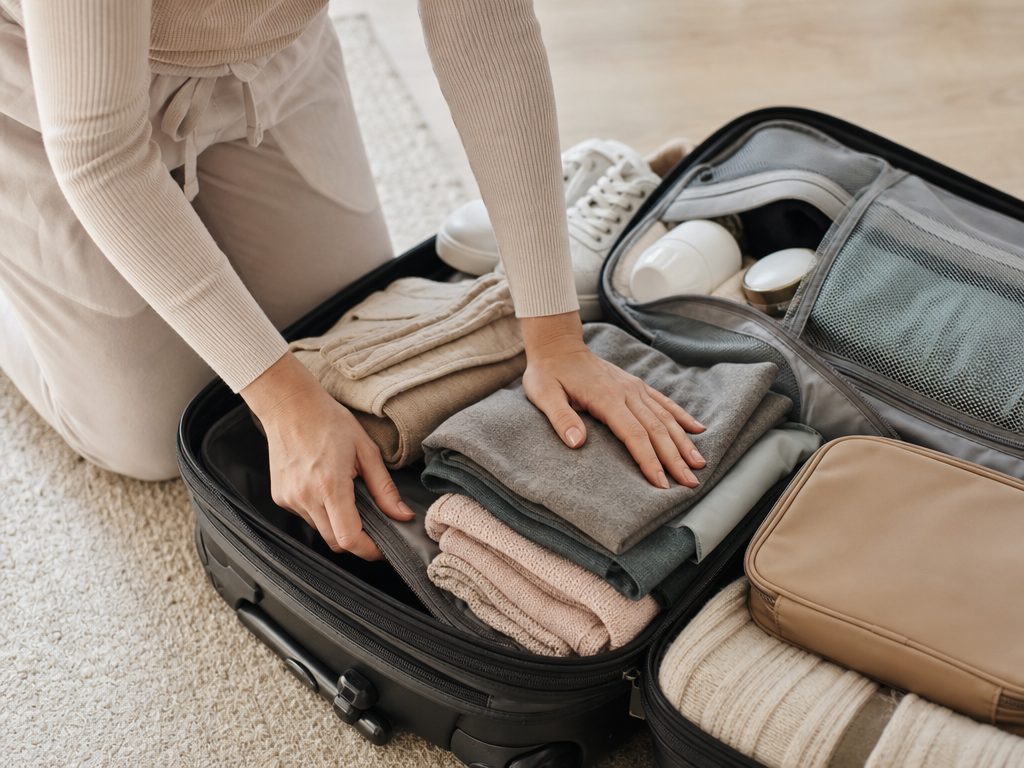
The secret to traveling indefinitely with only a carry-on is realizing that you do not need to pack a unique outfit for every single day of your trip. Whether you are traveling for a weekend, two weeks, or two months, you should only pack enough clothing to last five to seven days. To make this sustainable, integrate laundry into your travel routine. Doing laundry on the road is highly cost-effective and liberating, freeing you from the burden of hauling a massive suitcase across cobblestone streets.
For quick refreshes, practice sink washing. Pack a few lightweight, biodegradable laundry detergent sheets, which take up virtually no space and cannot spill. Wash your quick-dry synthetic or merino wool garments in your hotel sink, rinse them thoroughly, and use the "towel roll" method to speed up drying: lay the wet garment flat on a clean hotel towel, roll the towel up tightly like a sleeping bag, and step on it to extract excess moisture. Hang the garment to dry, and it will typically be ready to wear by morning. For larger loads, seek out local self-service laundromats or budget-friendly wash-and-fold services near your accommodation. This small effort pays massive dividends in mobility and comfort.
If you choose to use local wash-and-fold services, drop off your laundry in the morning to ensure a same-day or next-day turnaround. Alternatively, booking accommodations with an in-unit washing machine (such as an Airbnb or apartment hotel) once every seven to ten days can seamlessly resolve your laundry needs. By normalizing laundry as a standard part of your travel itinerary, you can easily travel for months with a single 40-liter carry-on bag, saving hundreds of dollars in checked bag fees and hours spent waiting at baggage carousels.
Navigating Airline Sizers and Gate Agents: The Fine Print of Baggage Policies
Before you zip your bag for the final time, perform a physical weight and size check. Fully pack your bag, lift it using a portable digital luggage scale, and measure its exterior dimensions, including the wheels and handles. Many travelers overlook the wheels, which can add an extra inch or two and cause a bag to fail a gate agent's sizing box test. Baggage weight limits and dimensional allowances are highly volatile and vary dramatically between carriers, especially budget airlines.
In 2026, the era of the manual luggage sizer is rapidly evolving. Many airlines are replacing random gate checks with advanced AI-powered 3D scanning cameras that measure your bag's volume in three dimensions as you walk through the boarding lane. Because of this precision, the margin for error has vanished. If your bag exceeds the allowed dimensions by even a fraction of an inch, the system automatically flags your boarding pass, forcing you to check the bag at the gate for a steep fee. Because airlines frequently update their fee structures and size definitions, always check your specific carrier's official website within 48 hours of departure to confirm their current limitations. For example, you can review Frontier's current baggage fee structure and size limits on the Frontier Airlines Bag Options page or Ryanair's current guidelines on the Ryanair Baggage page. If your bag is tracking close to the weight limit, wear your heaviest jacket, boots, and pocket your densest electronics during check-in to safely bypass the scale. This simple trick can save you from unexpected fees and the hassle of repacking at the gate.
Sources: www.flyfrontier.com, www.ryanair.com
The Post-Trip Audit: Refining Your Master Packing List
The final step in mastering the art of the carry-on occurs after you return home. Before you wash your clothes and put your suitcase away, perform a post-trip audit. Lay out all the items you packed and divide them into two piles: things you used frequently and things you did not touch (or only used once). Be brutally honest during this post-mortem. If you brought a heavy jacket "just in case" but never wore it, or if you packed four pairs of socks that remained rolled up, make a mental or physical note.
Use this data to update a master digital packing list in an app like Notion or Google Sheets. Over time, this list will become highly optimized, reflecting your actual travel habits rather than your anxieties. To streamline future trips, consider keeping a permanent "go-bag" stocked with travel-only essentials—such as a dedicated toothbrush, a universal adapter, and decanted travel bottles. This ensures you can pack in under fifteen minutes without the stress of forgetting crucial items, cementing your transition into a seasoned, minimalist traveler.
To make your post-trip audit even more effective, assign a score to each item based on its utility. Items with a score of 1 (never used) are permanently banned from future lists, while items with a score of 5 (used daily) are marked as non-negotiable essentials. This data-driven approach removes emotion from the packing process. By continuously refining your list, you will develop an intuitive sense of exactly what you need, allowing you to travel lighter, faster, and with complete peace of mind.
The Ultimate Carry-On Packing Checklist: A Step-by-Step Blueprint
To help you transition from an overpacker to a streamlined, minimalist traveler, we have compiled the ultimate carry-on packing checklist. This blueprint incorporates all the strategies discussed above, ensuring you never have to pay a gate fee or struggle with heavy luggage again.
Pre-Trip Preparation Checklist:
* Audit the Itinerary: Check the 10-day weather forecast for your destination and list specific activities (e.g., formal dinners, hiking).
* Check Airline Rules: Verify the exact carry-on and personal item dimensions for your specific airline within 48 hours of departure.
* Weigh the Bag: Use a digital luggage scale to ensure your fully packed bag is under the airline's weight limit.
The Capsule Wardrobe (The 5-4-3-2-1 Rule):
* 5 pairs of socks and underwear (preferably merino wool or quick-dry synthetics).
* 4 versatile tops (color-coordinated to match all bottoms).
* 3 bottoms (e.g., one pair of chinos, one pair of tech pants, one pair of shorts).
* 2 pairs of shoes (wear the heaviest pair on the plane; pack the lighter, versatile pair).
* 1 outerwear piece or hat (wear on the plane to save space).
The Toiletry Kit (The Solid Revolution):
* Solid shampoo and conditioner bars.
* Solid deodorant and toothpaste tablets.
* Decanted liquids (under 3.4 oz / 100 ml) in a single quart-sized clear bag (if flying through airports enforcing the 100ml rule).
The Tech Pouch:
* 1 multi-port Gallium Nitride (GaN) charger.
* 1 universal travel adapter with built-in USB ports.
* Consolidated cables secured with velcro ties.
* E-reader or tablet loaded with offline media.
By following this systematic blueprint, you can confidently navigate any airport, bypass long check-in lines, and enjoy the physical and mental freedom of traveling with only a carry-on.
- https://www.tsa.gov/travel/security-screening/liquids-rule
- https://www.tsa.gov/travel/travel-tips/travel-checklist
- https://www.spirit.com/optional-services
- https://www.ryanair.com
- https://www.gov.uk/hand-luggage-restrictions/liquids
- https://www.heathrow.com/at-the-airport/security-and-baggage/hand-baggage-and-liquids
- https://www.gatwickairport.com
- https://www.flyfrontier.com/travel/travel-info/bag-options/